
Does your water become cloudy within two days, even though you’re treating it properly? Does a persistent film cling to the pool walls after every swim? In 9 out of 10 cases, the problem isn’t with the products, but with the filtration time. A poorly adjusted cycle allows impurities to pass through, clogs the filter, and ultimately drives up your electricity bill.
The basic rule for calculating duration
The filtration system must circulate the entire volume of water at least twice a day. A 1,200-liter spa with a 10 m³/h pump filters its entire volume in about 7 minutes. In theory, 30 minutes is sufficient. In practice, biofilms, sunscreen residue, and organic debris require much more time.
The real rule of thumb is a simple formula: one hour of filtration per 10°C of water temperature. A spa at 36°C therefore requires at least 3 to 4 hours per day, spread out over several cycles.
Adjust based on attendance
The calculation changes as soon as people start swimming. Each user contributes sweat, skin cells, and cosmetics. Allow for an additional 30 minutes of filtration per person per swim. For a high-end spa used by a couple every evening, that easily adds up to 5 or 6 hours a day.
What settings should you use depending on the season?
The outdoor temperature directly affects bacterial growth. In winter, the water stays cold between heating cycles, so microorganisms grow slowly. Filtration for 3 to 4 hours a day is generally sufficient for moderate use.
In the summer, everything speeds up. Above 25°C ambient temperature, bacterial growth doubles for every additional 10°C. Increase filtration to at least 6 hours, divided into short 2-hour cycles to prevent stagnant areas.
During a heat wave
When the temperature stays above 30°C for several days in a row, continuous filtration becomes important. Some owners of outdoor spa switch to 24/7 mode during heat waves. The extra electricity consumption is negligible compared to the cost of a complete water change caused by water quality getting out of control.
Also, remember to cover the spa as soon as you step away. A snug-fitting cover limits evaporation and protects the water from direct sunlight.
After a night out, what should you do?
A party for six people, a birthday celebration, or a long happy hour in the spa? The next day, your water will have taken a beating equivalent to a week of normal use. Run a continuous filtration cycle for 12 to 24 hours, combined with a shock treatment using chlorine or active oxygen.
After a shock treatment, the rule is simple: filtration must run continuously until the disinfectant level has returned to its target value. Shutting off filtration during this phase allows oxidized residues to settle back to the bottom of the pool.
The Case of Clogged Cartridges
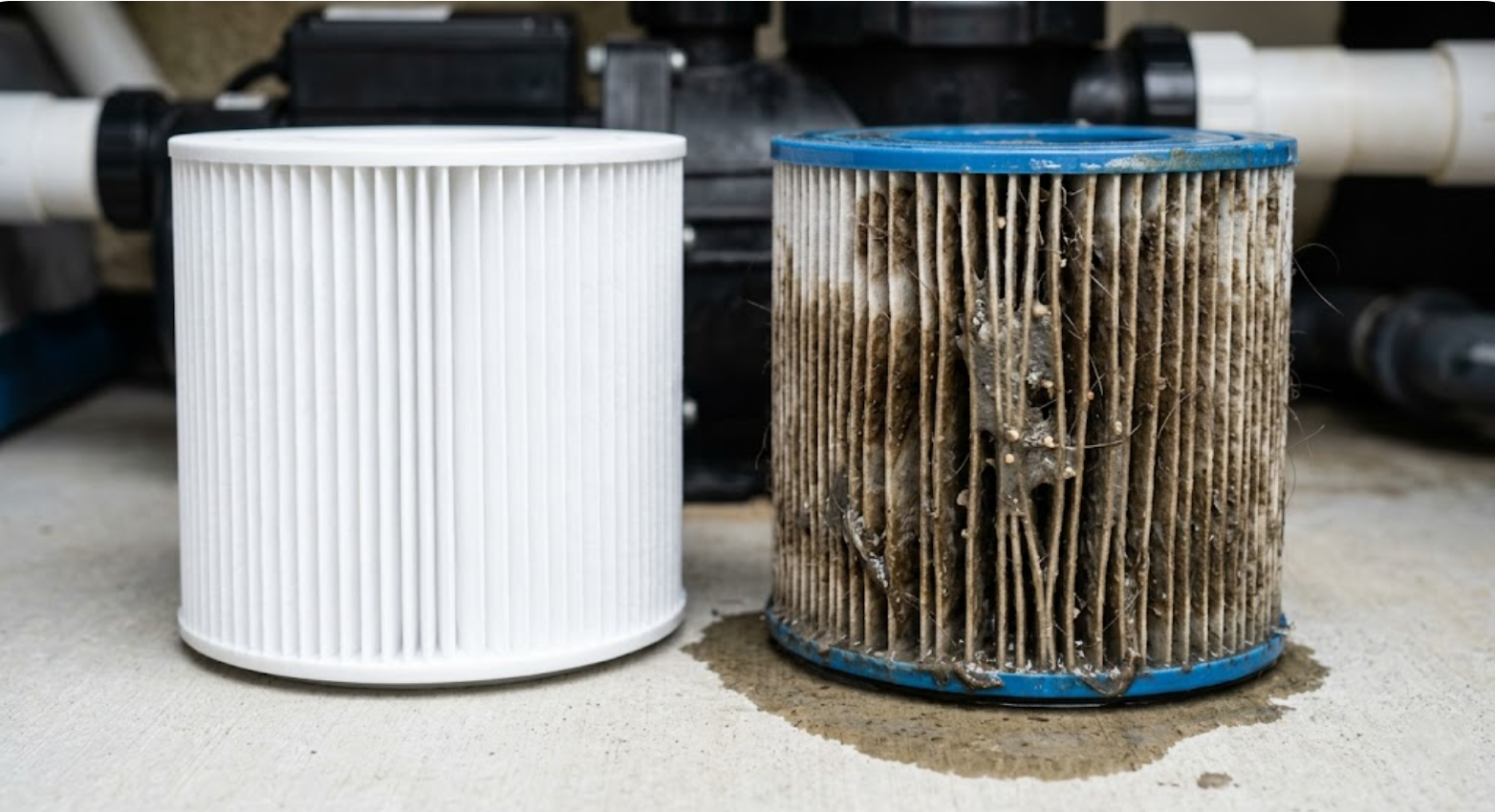
A saturated cartridge no longer filters; it slows down the flow rate. The heater then has to work against abnormal hydraulic resistance. The result: the water doesn’t heat properly, the motor strains, and energy consumption rises by 15 to 20%.
Rinse the cartridge with a high-pressure spray every two weeks. Soak it in a degreaser once a month. Replace it every 12 to 18 months, depending on usage.
Symptom, Diagnosis, Adjustment
Four signals to read in the order in which they appear.
Cloudy, slightly milky water. This is often the first sign of insufficient filtration or a worn-out filter cartridge. Increase the runtime by 2 hours and check the condition of the filter.
A strong, almost pungent chlorine odor. Counterintuitive: this isn’t due to excess chlorine, but to the presence of chloramines, which are saturated compounds. A shock treatment is required, followed by 24 hours of continuous filtration.
Greasy buildup on the waterline. Creams, cosmetics, organic residues. Clean the waterline with a suitable product, then extend the filtration cycle by 3 hours for three days.
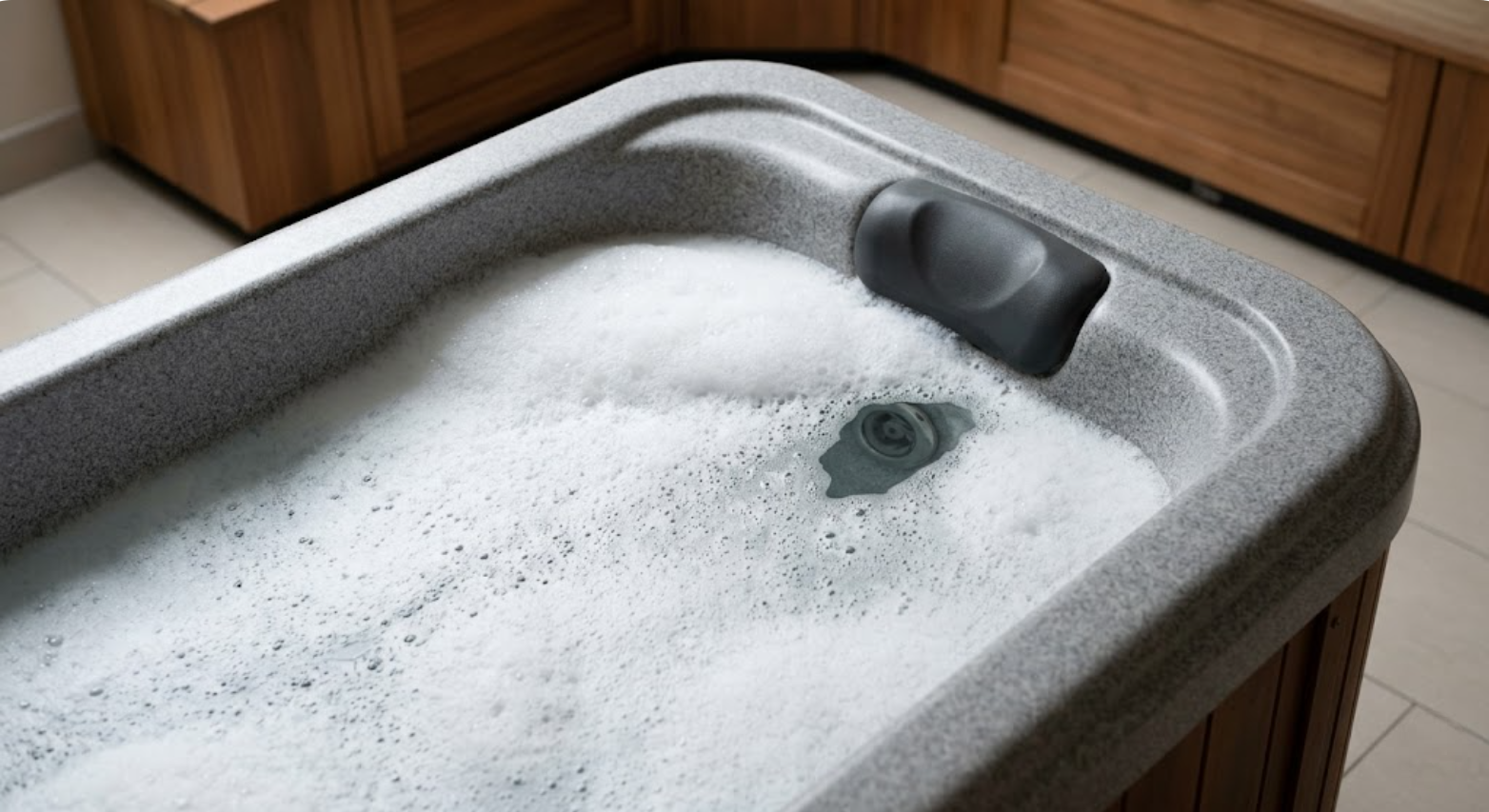
Persistent foam. Accumulation of organic matter and surfactants. Check the pH, perform a shock treatment, and consider a partial water change if the problem recurs within 48 hours.
Volume and Power: What's the Right Balance?
Not all hot tubs are created equal when it comes to filtration. A 8,000-liter swim spa with a capacity of 8,000 liters cannot be adjusted the same way as a 4-person model with a capacity of 1,200 liters. The pump’s flow rate sets the pace.
For a volume of less than 1,500 liters with a pump rated at 8 to 12 m³/h, 4 hours a day is sufficient for regular use. For volumes between 1,500 and 3,000 liters, allow for 6 hours. Beyond that, continuous filtration often becomes the most practical solution, especially for models equipped with a dedicated energy-efficient pump.
Proper adjustment means savings
A well-filtered hot tub heats more effectively. Consistent circulation evens out the temperature, prevents cold spots, and reduces heating time. Conversely, in an under-filtered hot tub, the water becomes stratified, forcing the system to compensate.
Over the course of a year, the difference between an optimized setup and a rough one amounts to hundreds of francs. Not to mention corrective maintenance, premature oil changes, and early replacement of filters.
Filtration isn’t a setting you adjust once and forget about. It changes with the season, the number of visitors, and the quality of the water used to refill the pool. Take five minutes each week to check your water, adjust the timer by one hour if necessary, and inspect the filter cartridge. This simple habit makes all the difference in the lifespan of your system.