
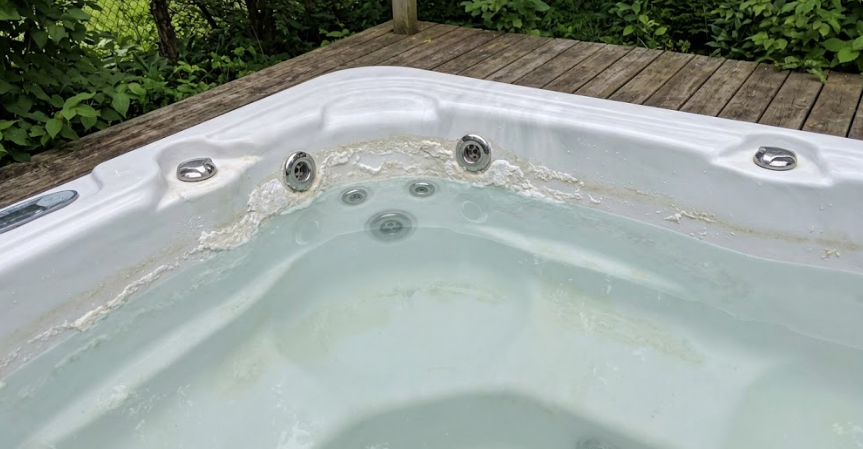
Does your water turn milky after a few weeks? Are white deposits appearing at the waterline? Is the heater taking longer to warm up than before? Limescale is likely building up in your spa, and every day that passes makes the situation worse.
Why Does Limescale Build Up So Quickly?
Hot water causes limescale to precipitate. It’s a fact of chemistry: the higher the temperature, the less calcium remains dissolved. At 37°C, your water naturally releases the minerals it contained in dissolved form. These minerals then settle on the hottest surfaces.
Electrical resistance is the first casualty. Even a thin layer of scale insulates the metal and forces the system to run longer. Next comes the deterioration of pump bearings, the gradual clogging of jets, and the appearance of cloudy water that resists all treatments.
pH, TAC, TH: Three Measurements That Should Not Be Confused
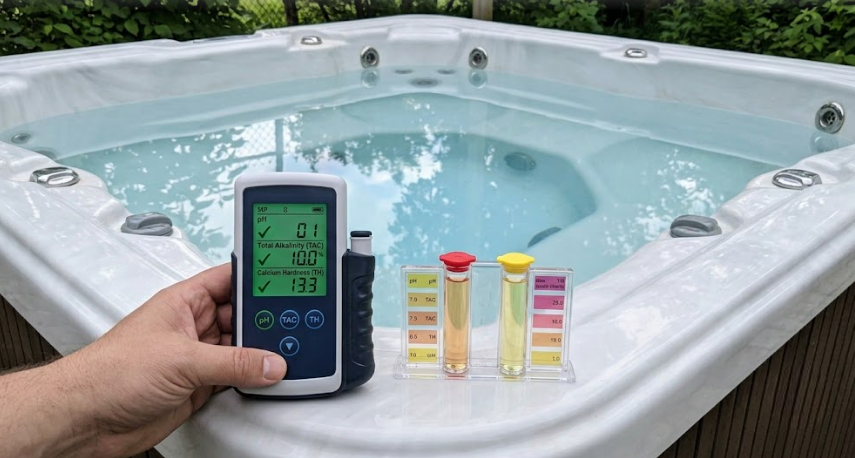
The pH measures the acidity of water. The TAC (total alkalinity) measures its ability to stabilize this pH. The TH (hydrotimetric titration) measures hardness, i.e., the amount of dissolved calcium carbonate.
A pH that is too high accelerates the precipitation of calcium carbonate. An improperly adjusted TAC causes the pH to fluctuate wildly. A high TH at the time of filling means you’re already starting with saturated water. All three must be monitored together.
Pre-filter as you fill
It all starts with the fill water. In French-speaking Switzerland, water hardness varies greatly from one municipality to another. In some areas, it exceeds 35°fH, which is extremely high for a spa.
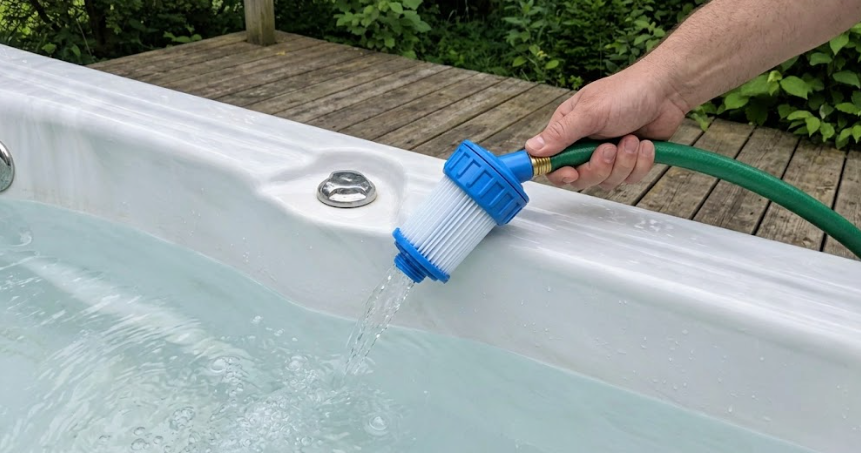
A prefilter that screws onto the garden hose captures some of the calcium before it enters the tub. This is the most cost-effective step you can take to extend the life of your system. Our high-end Jacuzzi spas come with specific recommendations on this point, as the initial water quality determines everything that follows.
Without prefiltration, you’ll start with a buildup of limescale that nothing will be able to remove later.
Stabilize the TAC to stabilize the pH
The ideal TAC is between 80 and 120 mg/L. Below this range, the pH becomes unstable and shifts toward acidity or alkalinity at the slightest addition. Above this range, the water is prone to scaling.
Many users adjust the pH without touching the TAC. The result: the pH rises again a few hours later, so they add more, and the cycle continues. Adjust the TAC first, then adjust the pH. In that order.
The Right pH Level for a Hot Tub
Aim for 7.2 to 7.4. Above 7.6, lime precipitates heavily, and chlorine or bromine lose their effectiveness. You’ll have to treat the water more often, spend more money, and the water will remain cloudy.
Scale Prevention and Waterline Cleaning
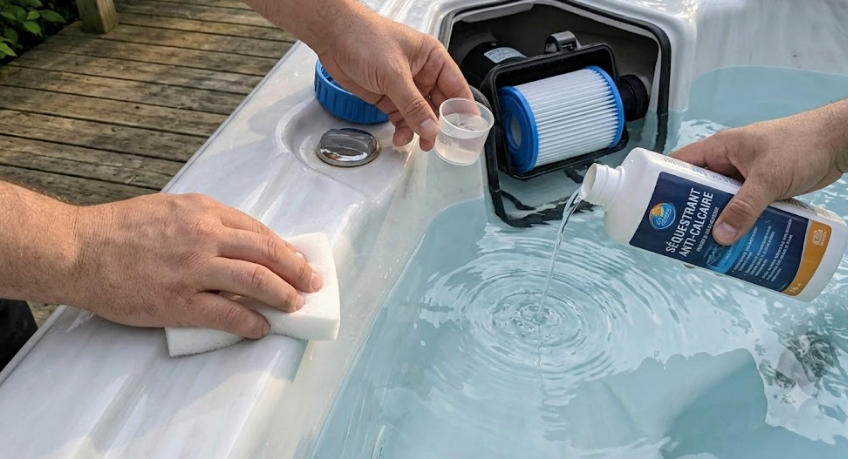
A limescale inhibitor keeps calcium in solution. It doesn’t remove it, but it prevents it from depositing on the heating element and the jets. Add it weekly, according to the manufacturer’s instructions.
The waterline, on the other hand, requires weekly cleaning. This is where body oils, cosmetic residues, and limescale combine to form a stubborn crust. A mild cleaning product is sufficient, provided you clean it regularly. Use a non-abrasive sponge, never use a green scouring pad on acrylic.
The rigid spas have the advantage of a smooth surface that’s easy to clean, provided you act quickly.
Descaling and Maintaining the Filters
Even with a perfect maintenance routine, scale eventually builds up in the system. A thorough descaling once or twice a year, when draining the system, removes these invisible deposits. The descaling solution circulates with the pump running for the specified time, then the system is rinsed thoroughly before refilling.
Filters deserve just as much attention. Rinsing them weekly with clean water removes surface particles. A monthly degreasing soak removes embedded oils. And descaling them quarterly in a suitable solution restores the cartridge’s porosity.
A clogged filter makes the pump work harder. The pump overheats, its seals wear out, and its flow rate decreases. Limescale takes advantage of this slowdown to build up even more.
Choose products that are compatible with each other
Not all treatments are compatible. A phosphonate-based sequestrant does not mix well with certain disinfectants. An anti-foaming agent combined with a flocculant can clog the filter in just a few days.
Stick to a consistent line of products from the same manufacturer, or ask for advice before mixing. outdoor spas exposed to weather fluctuations require extra attention, as water temperature and evaporation constantly alter the chemical balance.
Mistakes That Make Limescale Worse
Some habits actually speed up tartar buildup instead of slowing it down.
- Fill with softened water : A water softener replaces calcium with sodium. The water remains harsh on seals and completely destabilizes the TAC.
- Overdosing with pH+ : Raising the pH above 7.6 causes dissolved calcium carbonate to precipitate instantly.
- Neglecting the TAC : Without a buffer, each addition of the product causes the pH to swing to extremes.
- Piling on miracle treatments : Using too many products can cause incompatibilities and overload the filters.
- Delaying an oil change : After 3–4 months, the water accumulates too many minerals to remain treatable.
A simple routine beats an intensive treatment
Measuring the pH and TAC twice a week, adding the chelating agent on the weekend, cleaning the waterline, and rinsing the filters: these tasks take ten minutes. They prevent the need for major maintenance and preserve the technical components over time.
Limescale cannot be fought with sporadic efforts. It’s prevented by regularly monitoring water chemistry and keeping equipment clean. If you’re unsure about the right routine for your pool model or the water hardness in your area, our team is here to answer your questions and help you keep your water crystal-clear year after year.