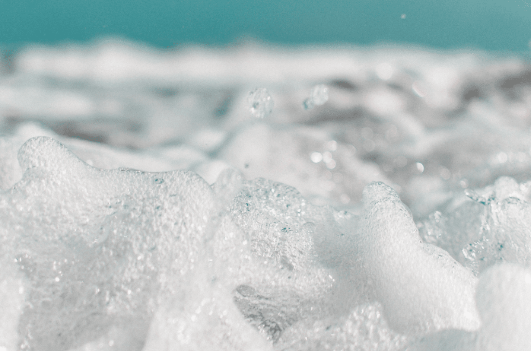

You turn on the jets, and white foam builds up on the surface. Sometimes it happens within minutes; other times, it takes several baths. The problem isn’t just cosmetic: the foam almost always indicates contaminated water and an imbalance that can quickly get out of hand.
The good news: in most cases, you can regain control in less than 30 minutes—provided you address the cause, not just the symptom.
Foam is a symptom, not an inevitability.
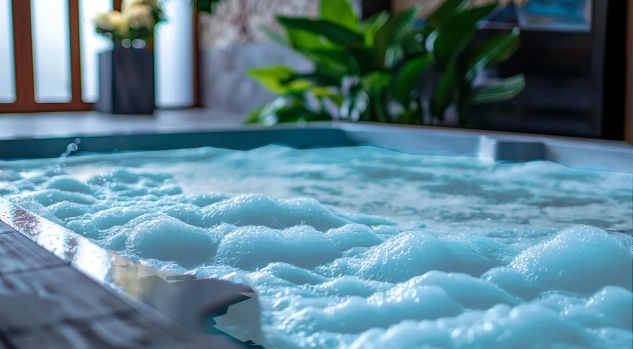
Why does water foam?
Are you wondering where that’s coming from, even though the water seemed fine? In a spa, the air and jets churn up the water. They bring to the surface anything that resembles soap, oil, or organic pollution.
Foam forms when surfactants and dissolved substances accumulate and then stabilize as a result of agitation.
The number one culprit: residue from cosmetics and personal care products. Creams, oils, makeup, deodorant, and shower gel that hasn’t been rinsed off properly. Even in small amounts, these products dissolve in hot water and turn into foam as soon as the aeration process begins.
The second most common cause: washing the jerseys. A jersey washed with scented detergent—or, worse yet, fabric softener—releases foaming agents when it comes into contact with hot water.
According to the EPA, environmental standards for surfactants require biodegradation (often >60% within 28 days), but in a spa, you are not part of a natural degradation cycle. Residues can linger and continue to foam for a long time.
When Disinfectant Isn't Enough
What if the real problem isn’t the foam, but rather what the water can no longer handle? Foam that reappears quickly after cleaning often indicates a lack of disinfectant or a pH level outside the target range.
In this case, organic matter builds up, the water becomes contaminated, and the spa’s filtration system can no longer keep up. Foam becomes a visible sign of an invisible problem: the water is no longer oxidizing the substances you add to the spa effectively enough.
If the foam comes back quickly, the water is already late.
At Atelier Nordic, we see this most often in very comfortable, heavily used hot tubs, where the water is treated like a small swimming pool… but with much less water per person.
And outdoors, this is even more true: an outdoor spa can sometimes pose an additional challenge due to dust, pollen, and tiny particles that cause it to get dirty faster.
What risks lie behind the foam?
Let’s be clear: the foam itself isn’t poisonous. The risk comes from what it reveals: contaminated water—sometimes inadequately disinfected—in a warm environment where germs thrive more easily.
According to the CDC, to reduce the risk of hot tub rash (Pseudomonas folliculitis), recommendations for hot tubs call for a free chlorine level of at least 3 ppm (mg/L), a bromine level between 4 and 8 ppm, and a pH between 7.0 and 7.8. The CDC also recommends the same pH range (7.0 to 7.8) and a free chlorine level of at least 3 ppm for home hot tubs, and advises against the use of cyanuric acid in hot tubs.
Hot water amplifies everything. Even mistakes.
Another point to keep in mind: the effectiveness of the disinfectant depends on the pH and the conditions. The CDC publishes approximate inactivation times at 1 ppm of free chlorine (pH 7.5, 25°C, without a stabilizer): E. coli in less than a minute, hepatitis A in about 16 minutes, Giardia in about 45 minutes, and Cryptosporidium takes much longer.
A spa operates at a higher temperature, with more circulation and chemistry that changes rapidly. You’d better not let the residue fall.
Some operational guidelines for public spas even specify a free chlorine range of 3 to 10 ppm and a pH of 7.2 to 7.8, with possible closure if levels fall below 3 ppm. This isn’t your home setting, but it gives an idea of the health standards required when usage is heavy.
Action Plan: 30 Minutes Flat
You want practical advice, not theory. The goal: to eliminate foam, restore proper disinfection, and get the spa’s filtration system back on track.
You won’t get anywhere if you add an anti-foam product without correcting the water quality.
Minutes 0–10: Test and correct
Turn off the air injection if your spa has one, then let the pumps run in filtration mode.
Test immediately: pH, alkalinity (TAC), and disinfectant (chlorine or bromine).
In a hot tub, test strips may be sufficient for a quick decision, but a drop test kit is more reliable.
Aim for the range recommended by the CDC: pH between 7.0 and 7.8. If the pH is too high, the disinfectant loses its effectiveness. If the pH is too low, the water becomes harsh and unstable, and it can irritate the skin.
If your disinfectant level is low, raise it immediately. Foam appearing around the jets is often a sign that oxidation is no longer keeping up.
Minutes 10–20: mixing and filtration
Perform an intensive treatment tailored to your disinfection method. The goal is to oxidize the organic matter that feeds the foam.
Then let the filtration run with the lid open to promote degassing and prevent byproducts from accumulating under the lid.
No lid during the impact.
In a well-insulated, rigid hot tub, the temperature rises quickly when the pumps are running. Just make sure the cycle remains stable and that the water is circulating properly.
Our hard-sided spas are designed for effective filtration, but no amount of filtration can compensate for overloaded water if the underlying cause isn’t addressed.
Minutes 20 to 30: Filters and loading
Rinse your filter cartridges under running water, paying special attention to the folds. If you have a second set, swap them out right away: you’ll be able to resume filtration with a clean set while the other set soaks and is degreased.
If there’s still a lot of foam, or if the water looks greasy, perform a partial water change. This automatically lowers the concentration of surfactants and dissolved substances.
Then top off the water level, and retest the pH and disinfectant levels.
One thing that’s often overlooked: the waterline. Wipe it down. Greasy deposits redissolve with every swim and cause the foam to build up again.
How can I avoid having to go back?
So now, how can you avoid the same thing happening again tomorrow? You can have perfect chemistry and long-lasting foam as long as the inputs continue. In a spa, user hygiene is half the battle.
Take a quick shower before your bath, without any oil or lotion on your skin. After swimming, the CDC recommends taking a soapy shower. It’s simple, but very effective at preventing skin irritation and reducing what you shed during your next bath.
A jersey can pollute for weeks.
Wash your swimsuits without scented detergent or fabric softener. Rinse them thoroughly with clean water. Ideally, set aside swimsuits exclusively for the spa, so they aren’t washed in the machine with other items that have a high detergent load.
Also, avoid adding products not intended for use in a spa: bubble bath, incompatible essential oils, or household cleaners for the tub. Surfactants are designed to create foam. They’ll do their job.
Finally, adjust the filtration settings to suit your usage. The more you use your hot tub, the longer you should run the filter and the more often you should clean the cartridges.
Hot, circulating water, when there isn’t much of it per person, heats up quickly. This is a law of physics, not a maintenance tip for your hot tub.
Guests: Switch to intensive mode
Are you having guests over? Everything changes: more sweat, more makeup, more fabrics, more temperature fluctuations, and the lid being left open.
The disinfectant runs out faster, and foam may appear as early as the first session.
Before the party: Make sure the water is safe
Test the pH and disinfectant levels the same day. Adjust them to fall within the range recommended by the CDC (pH 7.0 to 7.8, free chlorine at least 3 ppm, or bromine 4 to 8 ppm).
Verify that the filtration cycle is set for a longer duration over a 24-hour period and that the filters are clean.
If your pool is indoors, a indoor spa also requires careful monitoring of humidity and ventilation. Cleaner water also reduces odors and chloramines in the air.
After: catch up right away
As soon as everyone has left, restart the filtration process with the lid open, and test again. If the disinfectant level has dropped, correct it immediately.
If the water is already foaming, perform a shock treatment and rinse the filters the next morning.
If your spa is used as a full-fledged wellness center, with a sauna or steam room next to it, a clear hygiene routine makes all the difference.
At Atelier Nordic, our design team often incorporates a well-designed shower area into the design of professional wellness spaces, because it’s the detail that keeps water contained over the long term.
Would you rather spend 30 minutes correcting it, or put up with it for a week?