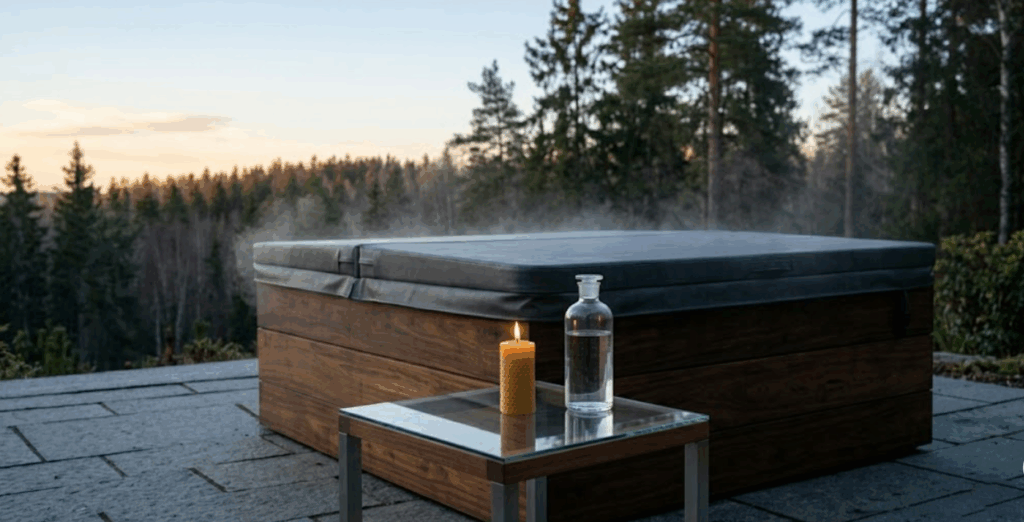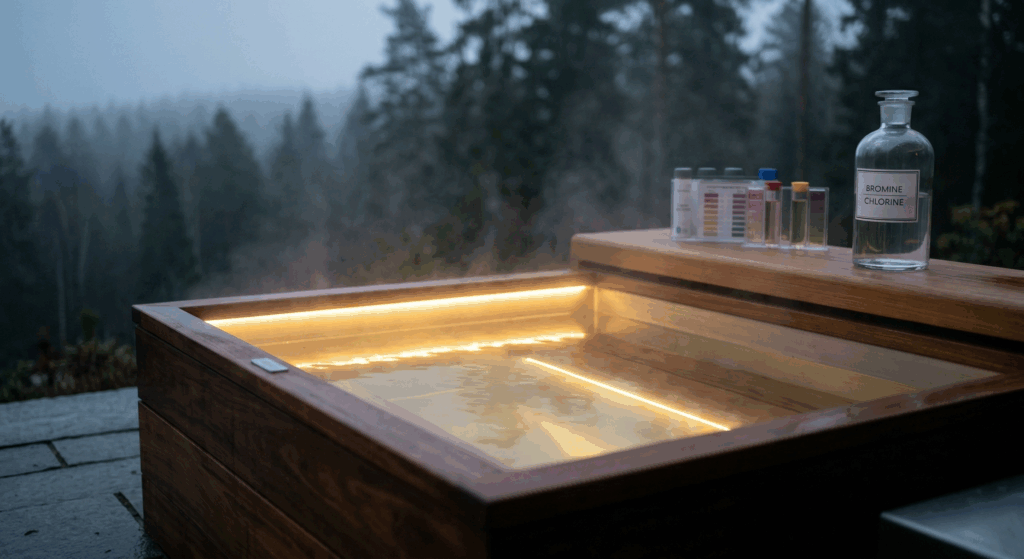
You’re looking for clean water without a strong odor, and maintenance that doesn’t eat up your weekends. Then you come across five solutions, five promises, and one simple question: which one really holds up at 38–40°C?
At Atelier Nordic, we often see the same confusion: UV and ozone are perceived as substitutes, when in fact they work primarily behind the scenes, within the filtration system. So let’s ask the real question: which disinfectant remains active in the pool between filtration cycles?
Why the Residual Changes Everything
A spa is not a quiet swimming pool. The water is hot, circulating, and aerated, and the organic load rises quickly as soon as there are several people in it. As a result, the disinfectant is used up more quickly, and water quality issues arise sooner.
High temperatures, sunlight, turbulence, and organic matter make it more difficult to maintain the disinfectant level in a spa. This factor is crucial when choosing a system, especially if you use it intensively or if you have visitors.
One thing remains certain: you need a residual disinfectant in the pool.
According to the CDC, in whirlpool spas/spa pools, the recommended residual level is 3.0 to 10.0 mg/L (ppm) of free chlorine, or 4.0 to 10.0 mg/L (ppm) of bromine. In commercial settings, health guidelines specify targets of 3–5 mg/L of free chlorine and 4–6 mg/L of total active bromine. These guidelines aren’t just for show: they serve as a reminder that treatment that leaves no residual cannot, on its own, keep the water safe between filtration cycles.
Chlorine: Effective, but Demanding
Chlorine remains the gold standard because it acts quickly and responds well to fluctuations—provided it is monitored. In spas, this responsiveness is useful when demand spikes after a group session.
But what about discomfort? The odor and the sensation on the skin do not come from pure chlorine, but from poorly balanced water loaded with byproducts. In practice, comfort depends heavily on pH, filtration, and the accuracy of dosing.
When it's hot, there's no room for error
In hot, turbulent water, conditions change rapidly. If you measure the dosage by hand, you may alternate between overdosing one day and having insufficient residual the next. This is typically where automation becomes valuable in hospitality settings or high-volume applications, because demand is not stable.
Compatibility and Daily Maintenance
Chlorine is compatible with most setups, provided you use the same products consistently and do not mix different treatment methods. In well-insulated that are well-insulated, thermal stability also helps keep the water more consistent, making it easier to manage.
When it comes to maintenance, expect to measure, adjust, and monitor more frequently after each heavy use. There’s no mystery to it: chlorine works very well, but it requires discipline.
Bromine: Designed for Hot Water
Bromine is often preferred in spas for one simple reason: it works well in hot water. It maintains a more consistent level of effectiveness as the temperature rises, which works well with the typical operating range of a pool at 38–40°C.
And what about comfort? Many users describe it as having a more subtle odor. How it feels on the skin also depends on the water’s balance, but bromine is frequently chosen when you’re looking for a gentler experience without sacrificing residual disinfectant.
There are control markers
Health guidelines specify target levels for commercial use of 4–6 mg/L of total active bromine. The CDC, for its part, recommends 4.0 to 10.0 mg/L (ppm) of bromine for spas and spa pools. These guidelines help you understand one thing: bromine needs to be managed; it doesn’t just settle once and for all.
Constraints: Follow the Water
Bromine does not eliminate the need to monitor pH and organic load. Warm water saturated with substances (cosmetics, sweat, swimsuit detergents) breaks down everything.
According to the Ministry of Health, ozone and UV light leave no residual disinfectant, and pH control remains essential; the same source also notes a toxicological recommendation regarding the maximum total bromine level (2.0–2.5 mg/L). This type of discrepancy between guidelines illustrates a reality: in spas, the goal is to strike a balance between health and safety, comfort, and operational constraints.
UV and ozone: useful as backup measures
Are you hesitant to switch entirely to UV or ozone? Keep in mind their role: they operate within the hydraulic system while the water is circulating. They improve microbiological quality and can help limit certain byproducts, but they do not protect the water while it is sitting in the tank.
No residual, no film.
UV: secondary, with maintenance
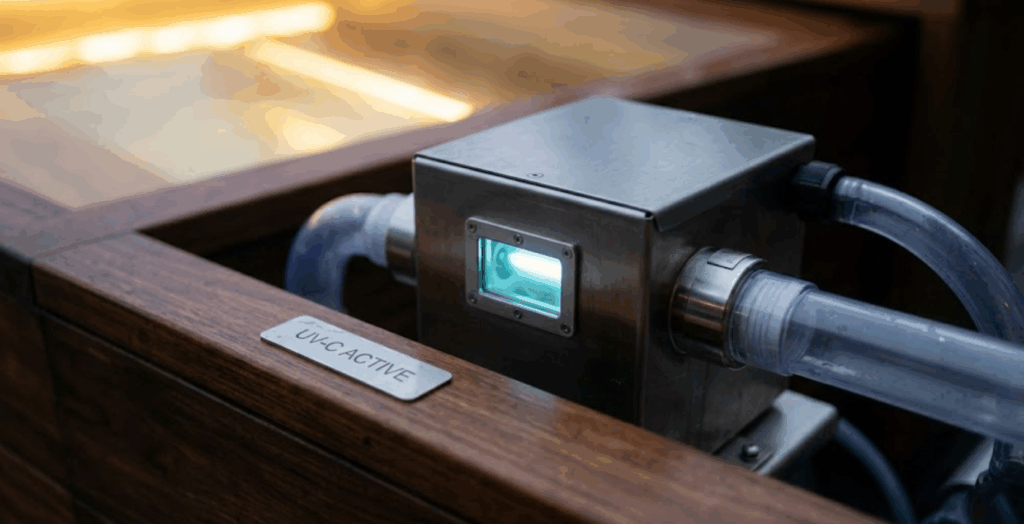
Pool Water Treatment describes UV as a secondary disinfection method, to be used in conjunction with a primary disinfectant, typically chlorine. The benefit is clear: to treat the water passing through the reactor in a repeatable manner.
The drawback is also clear: the lamps normally need to be replaced at least once a year, with typical lifespans of 4,000–9,000 hours (medium pressure) and 8,000–16,000 hours (low pressure), according to PWTAG.
In a spa, this is important because a UV lamp that is present but nearing the end of its service life gives a false sense of security. It is therefore essential to consider maintenance, accessibility, and monitoring—not just the initial purchase.
Ozone: Effective, but Needs to Be Integrated
We would like to remind you that ozone leaves no residual disinfectant. Its role is therefore to sanitize the water during filtration, as a complement to a halogen (chlorine or bromine). In practice, ozone requires proper integration: injection, mixing, contact time, and compatibility of the system’s components.
In an outdoor spa, where the water is more subject to fluctuations in usage and sometimes exposure to sunlight, a well-integrated secondary system can help stabilize perceived water quality. However, it never replaces the residual disinfectant measured in the spa.

Salt Electrolysis: Comfort and Caution
Salt electrolysis is often chosen for its ease of use: you simply add salt to the system, and the unit generates a chlorine-based disinfectant. In practice, this brings you back to a chlorine-based system, with on-site production and settings that can be adjusted to suit your usage.
The key point isn’t the promise of simplicity, but stability. If your hot tub is used frequently, production must keep up. If your hot tub is used infrequently, production must slow down; otherwise, you’ll end up with an excess of disinfectant.
Materials and the Environment: Long Term
Salt requires careful consideration of the compatibility of materials that come into contact with water, as well as the installation environment. Indoors, the atmosphere is already harsh on equipment; the addition of a saline environment can exacerbate these stresses if ventilation and room design are inadequate.
In an indoor spa, the coherence of the technical design is just as important as the choice of treatment.
Which system is right for you?
A good choice is rarely the absolute best system. It’s the one that fits your pace, your tolerance for maintenance, and the level of risk you’re willing to accept.
Sensitive skin: aim for subtlety
If your priority is skin comfort and a more neutral scent, bromine is often the most logical starting point for a spa. You can then add UV or ozone to the system as a backup, with the goal of maintaining more stable water quality without trying to eliminate residual chlorine.
Heavy-duty use: absorbing peaks
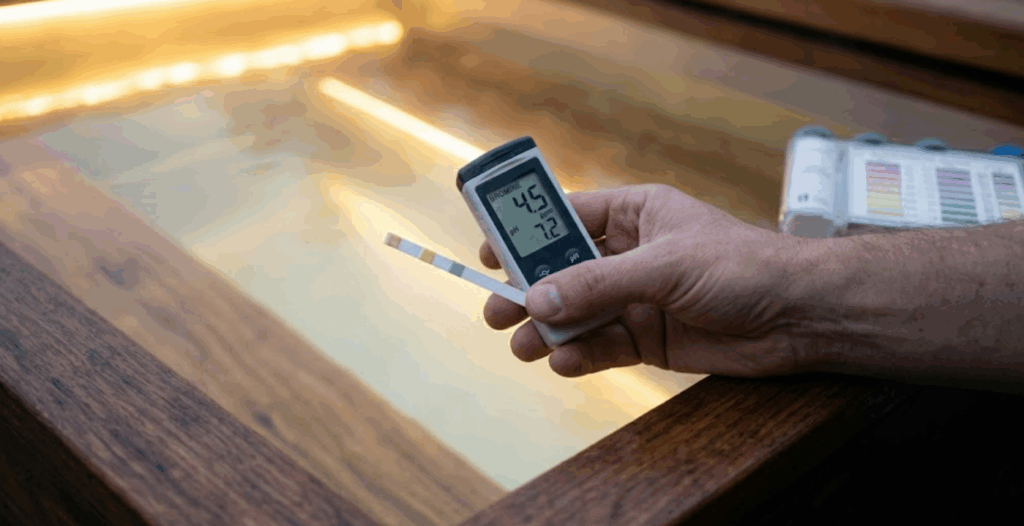
When the load varies significantly, you need a responsive disinfectant and regular monitoring. Chlorine or bromine are suitable, but success depends above all on control and consistency.
Recent guidelines emphasize the automation of dosing in commercial settings, precisely because rapid fluctuations make manual control unreliable.

Vacation Home: Dealing with Downtimes
If the spa sometimes goes unused for several days, look for a solution that handles periods of inactivity better and restarts cleanly. A secondary system (UV or ozone) can help during filtration cycles, but it doesn’t monitor the spa for you.
The basics: balanced water, filtration, and controlled residual levels.
The winning strategy remains balanced water, proper filtration, and controlled residual disinfectant levels upon completion.
Rental: Aiming for Reproducibility
In the tourism accommodation sector, reproducibility is becoming a top priority. We emphasize that heat, aeration, and organic load make it difficult to maintain consistent levels.
In this context, a combination is often sought: a primary disinfectant that can be measured in the pool, plus a secondary treatment (UV, sometimes ozone) in the circulation system, with scheduled maintenance and documented checks.
At Atelier Nordic, we design the treatment system as an integral part of the wellness project, just like thermal insulation, plumbing, and filtration. Tell us how often you use the pool, the number of users, and whether it’s for private use or commercial operation: we’ll guide you toward a realistic, stable, and easy-to-maintain long-term solution.